All work
Case study 01 · Industry research project with OpenPack (Klingele) & TH Ingolstadt

Shift handover that doesn't lose the night shift's knowledge

A research-led redesign of a B2B handover system for corrugated-board factories. In usability testing the redesigned flow cut task time and error rates against the existing module.

Role
UX Researcher & Designer (lead on research)
Team
International agile team, TH Ingolstadt × OpenPack
Timeline
Mar to Sep 2024, agile sprints
Methods
Contextual interviews, user flows, prototyping, usability tests
Users
Machine operators and shift leads
Tools
Figma, Miro, MAXQDA
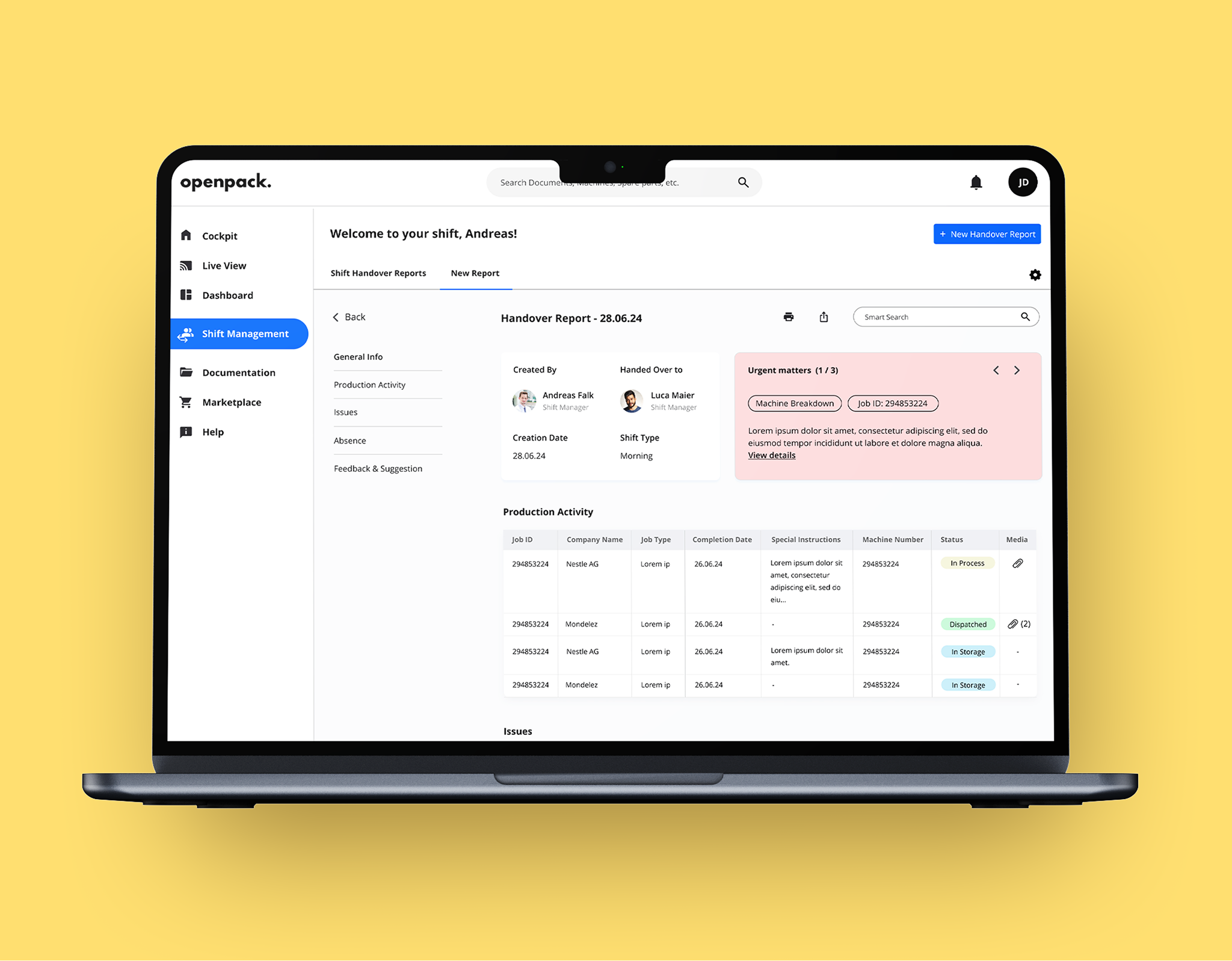
Klingele shift-handover dashboard, final design
The problem

[Your finding: where handover knowledge lived and what got lost between shifts.]

What I did

Led user research on site, mapped the real handover, redesigned the flow around what changed since the last shift, prototyped it in Figma and ran usability tests with operators.

The result

Faster handover tasks and fewer errors in usability testing. Methods and results presented to OpenPack; design decisions defended to non-design stakeholders.

Context

A corrugator runs around the clock. Every eight hours a new crew takes over machines that are mid-run, with quality issues, temporary fixes and half-finished orders that only the outgoing crew knows about.

OpenPack, Klingele's software unit, asked TH Ingolstadt to look at their existing handover module: it existed, but operators didn't use it. My job was to find out why, and to design something they would.

What I found, and what I decided

Three decisions, each with the evidence behind it

Decision 1 of 3

Operators don't write reports. They answer "what changed?"

Finding: [your finding, e.g. what happened to the free-text report in interviews]. Decision: replace the report form with a structured change log per machine, prefilled from machine data, so the operator only confirms or corrects.

[Before and after: report form to change log per machine]
Decision 2 of 3

Design for gloves, glare and 30 seconds

Finding: handover happens standing at the machine, often with gloves on. Decision: larger touch targets, high-contrast status colours that also differ in lightness, and a one-screen summary readable from arm's length.

[Photo from the site visit or the user-flow map]
Decision 3 of 3

Make the analytics view earn its place

Finding: [your finding about shift leads versus operators]. Decision: split the product by role. Operators get the handover; leads get an analytics view built with consumer-level clarity on complex data.

[Shift-lead analytics view, high fidelity]

Testing

Structured usability tests against the existing module

Task completion, time on task and error count measured against the existing module. Sessions recorded, think-aloud coded in MAXQDA. Findings from the first round were fixed before the next iteration.

Results

Less timeper handover task in testing
Fewer errorscompared with the existing module
Adoptedresults presented to and accepted by OpenPack

What I would do differently

Bring the non-design stakeholders in earlier. Defending decisions at the end took energy that a shared research readout at the start would have saved.

Keep observing before interviewing. What people told us about handover and what they did on the floor were different, and the design came from the second.